My Istanbul life in pictures

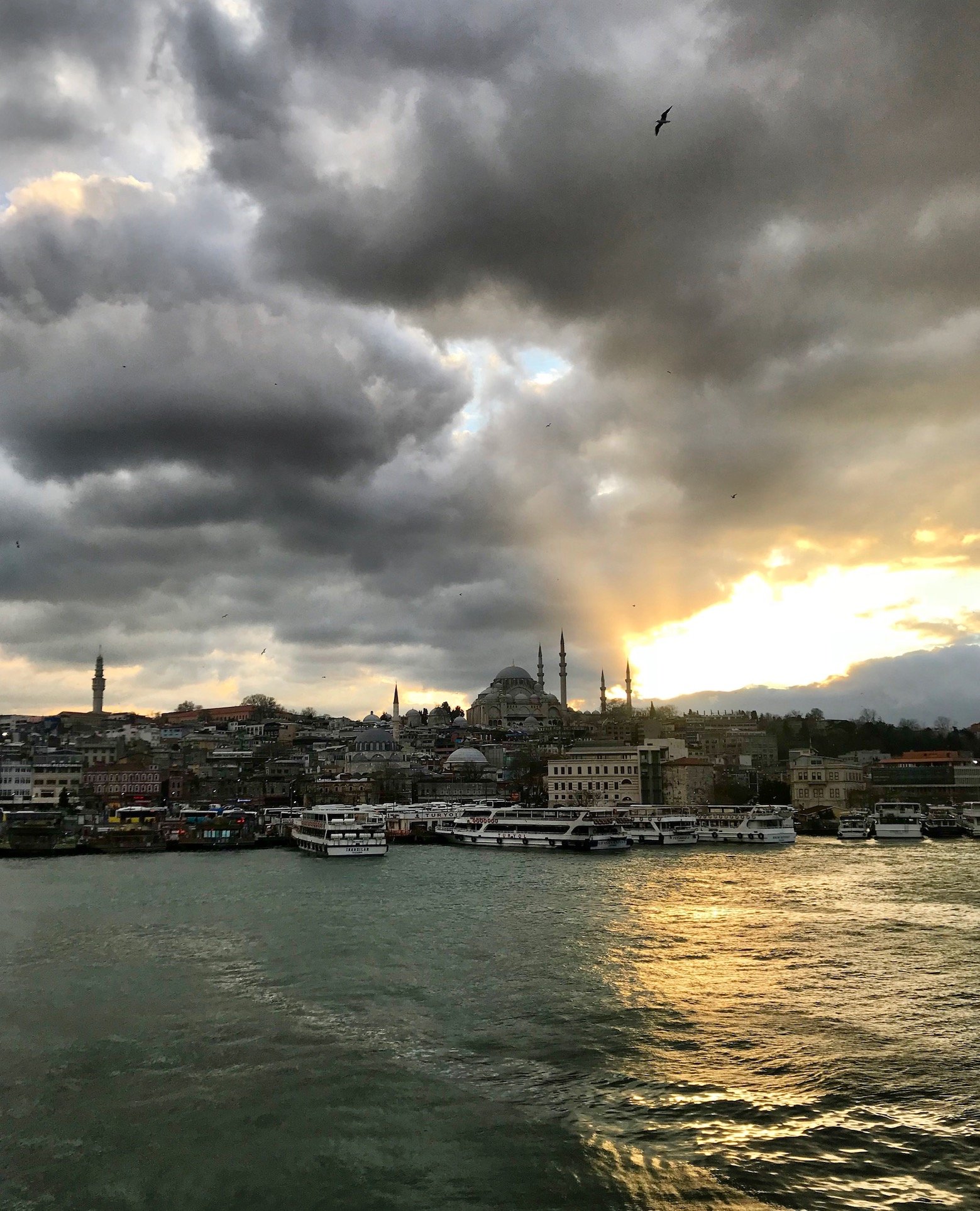
Finally, FINALLY the gray winter weather seems to have left Istanbul for the season. Which means my commutes around the city become much more enjoyable and instead of sitting inside buses and ferries reading I sit happily staring at the water and the sunshine and the scenes of Istanbul life passing by.

Here’s a very short video I took from the ferry as we set off from the Eminonu neighborhood at the mouth of the famous estuary known as the Golden Horn.

It’s lovely to be able to sit on the seats lining the outside of the ferry in the fresh air as the other boats cruise by. I like to look for dolphins and every once in awhile I’m lucky enough to spot a few!

If, like me, you prefer to get your peek inside the life of the city by visual means, I hope you’ll check out my Pinterest board “Istanbul Life”. If you haven’t joined Pinterest, you might want to check it out (and follow me!) I think it’s fun but also a useful way to collect things around the web you don’t want to lose track of.

Your turn!

I’d love to hear about your experiences—write ‘em up in the comments area below!

  • How does your experience of your city or town change with the seasons?
  • Where/how do you collect images? In a journal? In a photo album? Online?
Posted in Telling My Stories | Tagged , , , , , , , , | 2 Comments

Creativity + exploration: pinhole camera workshop

In the interests of practicing what I preach—getting out there and trying something new just for the fun of it, playing with no expectation of being an expert—I signed up for a pinhole camera workshop. Not only did I sign up, but I got out of bed on a Saturday morning and went! And boy was I glad I did.

So, how do you make a pinhole camera? The basic concept is to make a lightproof box with a removable lid (so you can insert and remove your photo paper) and a tiny hole to let in the light which can be covered and uncovered (your shutter). It sounds easy, and it is, but it does take a bit of experimentation to get the size of the hole and the shutter speed (how fast you open and close the hole) right.

Pinhold camera materials

Here we are with our materials which mostly consisted of cookie tins, black tape, and things to make holes with. John, of Cibali Arthouse, who taught the workshop, took one for the team and bought, and I presume ate, lots of cookies. Thanks John!

After taping up our lids to ensure they were light-proof, and making tiny holes covered with tape for shutters, we went into the dark room where we inserted photo paper into our new cameras. Then it was out into the streets of the picturesque and peaceful Cibali neighborhood on the Golden Horn of Istanbul to look for likely subjects.

Pinhole camera
Here’s my camera in action! That blob on the right side of the can camera is electrical tape my shutter, which is open to take the shot.

Now, here I must thank the lovely residents of Cibali, because we must have looked very suspicious and/or crazy, and they were good sports. Imagine eight people stalking around your neighborhood on a Saturday morning clutching cookie tins covered in tape to their stomachs (this seemed to be the preferred method for ensuring that the lids didn’t come off and expose our photo paper prematurely). After peering around, those people carefully set the tin down, peel off some tape, and start counting or looking at their watches. Then they replace the tape, grab their cans and dash back down the street. Crazy, right?

After dashing back into the art house we took turns in small groups to develop our photos. There was lots of crashing into each other. There was also lots of overdeveloped, completely black photo paper. We experimented with reducing our shutter speed, but it was no use. It was a really sunny day and our holes were just too big. Undaunted, we returned to the workroom and using various methods, including taping up the holes and poking tiny new holes with an earring (despite the name of the workshop no one had thought to bring an actual, uh, PIN), soon we were back on the street, clutching our cameras protectively to our stomachs.

Pinhole photos drying
Success!

Finally after much trial and error, we produced some images. Above you see a couple photos drying on the windowsill of the art house in the shadow of funky art house creatures.

Pinhole photo #1
Here’s one of the images I managed to capture. I like this one because if you look closely you can make out the cobblestones in the street and also a figure walking in front of the buildings. The photos produced this way are essentially negatives, so if you play around with them in photo editing software and reverse the image you’ll get a more recognizable black and white image.

This may not be the best photo I ever took, but it was really fun to experiment and see how easy it is to make a very basic camera and develop the film yourself. The process of trying and failing to get images didn’t dampen our enthusiasm, we just kept trying and manipulating variables until the images started to appear, by which point we were excited to see those ghostly shadows and shapes finally emerging.

And of course I took my cookie can camera with me and spent the rest of the day asking people, “do you want to see my new camera?”

Your turn!

I’d love to hear about your experiences—write ‘em up in the comments area below!

  • When is the last time you tried something new just for the fun of i?
  • What is the last new art form you played with?
Posted in Telling My Stories, Workshop Highlights/Making Art | Tagged , , , , , , , , , , , , , , | 4 Comments

Aspiring to be amateur

Easels

Here’s a question: who gets to call himself an artist? Is it the guy who sells the million dollar painting? The girl with the MFA? The renegade street artist? And what’s the difference between a “real” artist and an amateur artist?

This answers to this question have been the source of much squashing of creative talent, exploration, ability, and curiosity.

The definition I prefer states that if you’re a “professional” anything it means you get paid for it. Period. It doesn’t mean you’re good—or bad—at it. And being an amateur, a term which is sometimes used as pejorative with which to hit someone over the head, merely means you don’t get paid for it. It doesn’t mean you’re bad—or good—at it.

The belief that amateur means bad or sloppy is what causes people to hide their creative attempts away, or not to make them at all.

There is a difference between being a beginner and being an amateur and no shame in either.

Those clumsy first attempts to express yourself through writing, painting, or dance are just that: the first steps towards being an experienced amateur. And there is something wonderful about seeing someone pursue their passion for the joy of it and for no other reason.

Check out this link to an award-winning young photographer, one who doesn’t even necessarily accept the label of artist. He pursues his art almost by accident, as if it is merely a byproduct of his life as a “teenager-turned-supertramp”. He has incorporated his creative activity into his life in such a way that it is not the main purpose of his life, but the expression of it.

As Shelley Berc, expert on creativity and one of my teachers points out, “The word ‘amateur’–from the Latin ‘amator’ or lover–means to create for the sheer love of it”.  As she writes in her article The Gift of the Amateur, “It is only recently that the word ‘amateur’ became a dirty one. Until the 1980′s, just about every educated person no matter what his or her profession played an instrument, or painted, or wrote for pleasure. The aim of these hobbies wasn’t necessarily to become the next Beethoven but to deepen the sensibilities of the individual doing them.”

I say we take a step back in time and aspire to be amateurs—lovers—of creating our art.


Your turn!

I’d love to hear about your experiences—write ‘em up in the comments area below!

  • What arts do you pursue as an amateur?
  • Are you comfortable sharing those works with others?


Posted in What is Art/What is an Artist | Tagged , , , , , , , , , | 9 Comments

Weekend whimsy: creativity challenge

Creative mess-making: good for the soul! Creative mess-making: good for the soul!

I am usually very orderly. I hate to clean, but I love to organize, so I broke new ground when attending The Creativity Workshop in Istanbul last month. I got so excited by all the STUFF I was creating that I made a big mess, and had a grand time doing it. Photo evidence of the mess I made, along with my fellow participants, can be found above :)

My challenge to you for this weekend is: make a mess!

You could play in the dirt—it’s a great time of year to garden, whether that is outside in your yard or in a small pot on your windowsill.

You could get out those art supplies you stuck in the back of the drawer for “when I have time” and PLAY with them. No need to create a masterpiece, your challenge is to make a mess, the bigger the better. Just go play. For those good girls and boys who need it I hereby give you permission.

I think what you’ll find is cleaning up that mess takes less time and effort than you think, and even if not, it will have been worth it. There’s something about making a creative mess that’s good for the soul.

Have a fantastic weekend and don’t forget to come back and share what you did!

Posted in Telling My Stories, What is Art/What is an Artist, Workshop Highlights/Making Art | Tagged , , , , , , , , | 2 Comments

The Usual Foreigner

Istanbul Cat-BirdFish out of water or enjoying a fresh perspective?

Last week I walked into a longtime client’s office building and found a new security guard at the door. She said a lot of Turkish words I didn’t understand and also “canta”, which I know means “bag”, so after a brief pause I realized she wanted me to give her my bag to be searched. I was ready to hand it over when one of the more experienced guards intervened and told her that no, she didn’t need to search my bag because I am a “yabanci, normal”. No need for me to be searched or present ID; I was waved through, given my access card and sent smilingly on my way.

The words of that second guard recalled a question I’ve considered often: why, unlike so many expats, do I NOT feel like a “fish out of water”? I feel absolutely and completely at home in my skin as a “normal yabanci” which, loosely translated, means “usual foreigner”.

Here are a few reasons why:

Being foreign gives me permission to feel different in a “normal” way.
We all have that nagging feeling at times that we are outsiders or that no one understands us. By living in a place where I am by definition foreign, I feel zero obligation to fit in. I know I never will so the pressure is completely off. I try very hard not to be culturally inappropriate, but I don’t try to be culturally the same. Ever.

• Being foreign makes me special and memorable.
People are often thrilled to meet a foreigner. They are curious, interested, and welcoming when they first meet you and generally remember you and welcome you back when you return to a shop, workplace, or neighborhood haunt. Sometimes it’s nice to be considered “interesting” and the famous Turkish hospitality is often kicked up a notch for foreigners.

• Being foreign insulates me from doing stuff I don’t want to do.
There are many disadvantages that go along with being an outsider, so I feel no compunction at taking full advantage of the perks. If I don’t want to do something, I explain that yes, I am foreign, and weird, but that’s just how we Americans are. Silly Americans, we just don’t know any better, I tell them sadly.

Partly, I think my feeling of comfort comes from having found the right place for me. That is the true answer to the ubiquitous question, “why did you move to Istanbul?” The answer is: because I came here and it felt like home.

Your turn!

I’d love to hear about your experiences—write ‘em up in the comments area below!

  • Are you in your “right” place?
  • When/where do you feel like an outsider?
  • Does the idea of moving to a new town/city/country appeal to you? Why or why not?

Don’t forget to click here to sign up for my soon-to-be-relaunched probably twice-monthly newsletter!


Posted in Telling My Stories | Tagged , , , , , , , | 16 Comments

Peregrination and the summer reset

Don’t let the grass grow under your feet! Or maybe, do.

This is the most important time of year for me—summer break. When I go to a quiet village and sit by the seaside and immerse myself in the sea and try to find that crazy balancing point where you turn off your brain enough that it resets, jump starts, fires up, and takes off.

This year the angels of synchronicity have been especially kind. My vacation coincides with Kristin Bair O’Keeffe’s 38Write workshop which is delivered in such a way that I can participate from the little village of Assos, Turkey. The theme this month is “peregrination” which fits so well with my propensity to wander aimlessly when left to my own devices in a village. Or anywhere for that matter.

After a few days of aimlessness and feeling like I wasn’t even relaxing properly, I can feel the ideas breaking free. My mind is not so much peregrinating as flying over the hillsides and mountain tops in a million directions. My only job now is to try to capture as much of the raw material as I can and store it up for later use. And keep washing myself in the sea.

 What are you doing to break free and reset? Do you have an annual ritual? If so, please share in the comments!

Posted in Telling My Stories, Workshop Highlights/Making Art | Tagged , , , , , , | Leave a comment

Thinking and Feeling…and Walking

I have been mulling over the direction of my business (and life) a lot lately, going through one of those periods of introspection that are so unsettling yet, ultimately, always result in firming up and focusing my path and purpose.

One of the things I’ve been mulling is my life in Istanbul, why it works for me, what doesn’t work for me, having my own little “why am I here? moment. I can never quite put into words why I feel it is necessary to be here, and not somewhere else, but maybe this video sheds some light on that.

Istanbul is for me, the ultimate walking city. There is so much climbing and jostling and so much to look at: the huge spectrum of people, the span of history, layer upon layer, and all piled up together. There are monuments and sea views and skyscrapers and ferries and cats and dogs and tourists and natives one on top of another. There is chaos and there are surprising pockets of peace, right in the middle of it all.

This little three minute video speaks to me. In it, artist Maira Kalman says, “stop thinking, which usually I associate with some kind of problem. Stop thinking and just do whatever it is you think you need to do”. One of the ways she does this is by taking a walk.

Good advice, I think, because I do find that walking and the seeing that goes along with it relieve stress, help me find clarity, and often provide me with the raw materials and ideas I need for art, for writing, and even for making big life decisions. Being out there in that stew of a city provides perspective.

When in doubt, take a walk.

Right now, I am spending most of my time and energy on planning for my upcoming creative immersion workshop Playing Around Istanbul. But I’m also walking the city and plotting new programs and offerings. More on all that soon. Until then, enjoy this video and consider checking out my Istanbul workshop, there are still a few spots left!

Posted in Telling My Stories, Workshop Highlights/Making Art | Tagged , , , , , | Leave a comment

Playing Around Istanbul: the video!

Here’s a little video introduction to Playing Around Istanbul, the workshop I am doing this fall with partner Melissa Dinwiddie–we are so excited about this workshop! It will have a little bit of everything: art making, exploring an amazing city, meeting fascinating people… the list goes on.

Now is the time to sign up for the workshop, I can’t wait to share my adopted hometown with everyone!

Take a gander then be sure to ask any questions you may have about Istanbul or the workshop in the comments below–I’d love to hear from you!


Posted in Workshop Highlights/Making Art | Tagged , , , , , , | Leave a comment

Introducing Melissa Dinwiddie: passion pluralite and proud imperfectionist

One of the best things about running your own business is having the freedom to choose who you work with—and I think I have chosen well in selecting my partner, Melissa Dinwiddie. Melissa is a whirlwind of positive energy and such a pleasure to work with. Our weekly meetings often involve a lot of enthusiastic gesticulating, excitedly raised voices, and tangents that turn into tangible ideas of what we can do together. Another good thing about running your own business is that you get to call yourself a “Poobah”… but that is a different story.

Working with Melissa has taught me the value of a truly great partner: someone who thinks enough like you (we have similar teaching styles and goals), but is different enough that you balance each other’s strengths and weaknesses. Working with the details of the technology of online life is second nature to her where it makes me want to crawl under a rock, and she appreciates me dealing with the details of lesson structure and planning.


Currently, we are teaching a 12-week online course called “Playing Around Online” and we are having a blast. And, we are gearing up for our live fall program “Playing Around Istanbul”, which we are SO EXCITED ABOUT! You should definitely consider joining us in Istanbul. I am firmly convinced it is going to be the most awesome creativity workshop/arts immersion vacation that ever existed. That is if the world doesn’t screech to a halt when Melissa and I finally meet in person. Believe it or not, we met and (so far) work exclusively online. Thank you internets for introducing me to such a great partner!


Without further ado, I give you Melissa and her thoughts on being a Passion Pluralite, striving for imperfection, and living a creative life daily.

Melissa Dinwiddie

You talk a lot about being a “passion pluralite”. Tell us more about what that is and how it affects your work and play style.

I have come to realize that I am hard-wired to have multiple passions, not just one. Not only that, but I’m not happy unless I keep my toe in at least a few of my passions at all times.

Needless to say, that keeps me very busy!

For much of my life I fought this tendency of mine to want to follow multiple blisses. I often wished I could be happy picking one thing and focusing on that, and I even wondered if there was something wrong with me. Once I accepted and embraced that this is simply how I’m wired, I was freed up to figure out how to use my Passion Pluralite nature to my advantage.

Perhaps the most important thing I’ve learned is that I really do get to do everything, just not all at the same time. It took me into my 30s to figure that one out, but once I did, I stopped trying to run in multiple directions at once. At first, I determined to limit my focus to just two things at a time, but that wasn’t enough, so I expanded to three. Then four.

For me, about four passions at any given time feels about right: approximately the same number of major “focus areas” as burners on your typical stovetop. I think of my passions as pots on the stove, which I can rotate at will. There’s always one bubbling away on the front burner, which takes the bulk of my creative energies, but I’m happiest when I’m also keeping a few others simmering along at the same time.

That doesn’t mean I don’t get to have more than four-ish passions, just that I concentrate my energies on no more than about four at any given time. To stick with the cooking metaphor, my other interests get to hang out in the metaphorical refrigerator or pantry until I’m ready to move a current pot off the stove and bring a new one into the rotation.

I allow the rotating of the pots to occur on its own rhythm, and I find that my focus areas seem to pull strongly at me for about 3 to 9 months at a time, after which point I usually find myself compelled more strongly by another focus area.

I used to feel badly about myself for not sticking with a focus area. I love the pursuit of mastery, and for a long time I lamented that I’d never achieve the level of mastery in any one of my passions that I could be if only I would limit my focus and stick with it. However, now that I know this is my modus operandi, I enjoy the flow of it all. It’s true, I’ll never be “The Best” at any one of my passions, but I’ve decided that’s okay with me. I’d rather have the breadth of passions and expressions, plus honestly, I’d get bored!

I’ve also figured out that it’s not mastery that makes me happy, but the pursuit of it. Realizing that helped me let go of my need to “achieve greatness.”


What allowed you to set off on your creative path? Did you have a sudden revelation that things had to change or was it a gradual shift?  

It was both, really. If I look back on my life, with the exception of a few dry and painful years when I was an academic, creative expression has always been part of my path. As a child I drew and painted and sang and played instruments without thinking much about it. Then at 16 I discovered dance, my first real passion. At the time I didn’t realize that I would ultimately have many passions, I just knew I was in love. When an injury forced me to stop dancing I thought my life was over, or at least the passionate part of it.

Years later I discovered my next big creative passion, calligraphy. It was a revelation that I got to have more than one passion! Then I got dance back in a different form, with ballroom and salsa dancing, which made me realize that hey, maybe there wasn’t a limit on this passion thing! Maybe I got to have as many passions as I wanted!

Later I picked up the guitar and dove into that for a bit, then discovered a real passion for singing, particularly jazz, and much later I discovered that I have a passion for writing songs.

Each of these discoveries was a revelation at the time, but they gradually revealed themselves over a period of many years. The big, sudden revelation, though, came a couple of years ago. I had let my creative passions gather dust in a corner, believing I didn’t have time for them. A major life crisis made me realize how very unhappy I was. Something cracked open for me–I refer to it as the Universe whacking me upside the head with a 2×4–and I realized that if I wanted to live the fully creative life I really, really wanted, I was going to have to make it happen. I realized that it was a choice that I, and only I, had control over.

I determined to make that fully creative life my reality, and I’ve been embarked on that journey ever since.


What did you have to give up breaking free to be you?

I had to give up a very old, ingrained idea that I had to be perfect in order to be okay.  That “good enough” was never good enough. I still pursue excellence in everything I do, but I used to have a sense of desperation around being “The Best.” That’s a pretty heavy burden to carry around! What a relief to finally accept that I’ll never be “The Best” at anything except being myself! My teenage self would call me lazy, but now I feel like being myself is really the only thing worth trying to be the best at.


You say that you “strive for imperfectionism”. Why do you think that is important? Do you think you will ever complete the journey and become and imperfectionist extraordinaire?

I intentionally combine the words “striving” and “imperfection” because they seem so ridiculous together. I think it’s important, though, because perfectionism stops so many of us in our tracks. When our standards are “perfect or bust,” we end up giving up altogether.

My goal is not to just dream, but to actually create and produce (and I know I’m not alone!) In order to do that, I’ve had to let go of my perfectionist tendencies. I’ve made myself become much more interested in getting my creations out in the world than in tinkering until everything’s “perfect,” because nothing can ever be perfect!

Do you know the story of the ceramics class, where the instructor divided the class into two groups, one that would be graded solely on the quality of their pots, and the other solely on the quantity? It’s not surprising that that latter group had a lot more fun, cranking out pots, laughing and chatting, totally unconcerned about making any one pot perfect.

The really interesting thing, though, is that the highest quality pots also came out of the group that was only graded on quantity! Through the very process of making so many pots, they naturally learned what worked and what didn’t, and their pots improved. The “quality” group never had that opportunity to learn, because they were too busy laboring over the few pots they tried to make perfect.

To me, striving for imperfectionism means treating my own work like the “quantity” group in that ceramics class. Create, produce, and learn from the experience.

Becoming an imperfectionist has also helped me to accept myself as I am, rather than constantly be berating myself for not meeting up to impossible standards.


What is your #1 rule for living well when life sucks?

Do something you know gives you joy, even if you think you don’t feel like it. Also take naps. And go on walks by the Bay.


What’s the first sign you’ve overdone it?

Oooh.. anytime I feel resentment, it’s usually a clear sign that I’ve taken on too much. When I lose my normal zestful energy, that’s a good clue, too!


What is one thing you say “no” to, and why?

I used to sit on a lot of boards and committees for various nonprofit organizations I belong to. I’ve learned, however, that until my own needs are fully met — including my needs for Creative Sandbox time — giving my time away like that does not lead to happiness! So I’ve learned to say no to volunteer work, even when it makes me feel guilty!


How are you living a creative life? How are you following your evolving bliss right now?

I live a creative life by making time just about every single day to do the creative passions that give me joy. Whether it’s writing, or visual art, or making music, or creating a video, or creating a new course or offering for my business, I put feeding my creative spirit at the top of my priority list and (this is key) I make time for it. The specifics change as my blisses evolve — I might go for weeks without painting while I focus on writing, for example, and then vice versa — but I make sure to feed my soul in whatever way it is asking to be fed. That, to me, is the essence of living a creative life.
Creative woman, it's your time...

You can find Melissa on her website Living a Creative Life and check out her new program Time to Glow for women who are ready to stop putting off their passions and live the creative life of their dreams. That’s an affiliate link, by the way, my first ever, so you know I really believe in what she is doing!


And don’t forget to check out our Playing Around Istanbul workshop. The time to sign up is now!


Posted in Telling the Stories of Others, What is Art/What is an Artist, Workshop Highlights/Making Art | Tagged , , , , , , , , , , , , , , , , , , , , , , , , , , , | 1 Comment

The new normal; why you should embrace your weird


In a recent session of Playing Around Online, the workshop I’m running with my partner Melissa Dinwiddie, we focused our attention on limits and barriers. What began as a discussion of overcoming limits led to a discussion of the limits we place on ourselves and the perceived barriers thrown up by criticism or simply lack of praise from others. The Playing Around Online group is made up mainly of artists, but I think something we all struggle with is: who should we listen to when we ask for constructive criticism? Who are we trying to please? Do we care what others think? Should we?


What I heard from workshop participants was disappointment at not receiving more enthusiastic responses to their work, frustration at not being understood, and discouragement because they felt their work was not valued. I was still thinking about these reactions as I read We Are All Weird by Seth Godin, and was struck by his definitions of “normal” and “weird”:


“NORMAL is what we call people in the middle. Normal describes and catalogs the defining characteristics of the masses. Normal is localized–being a vegetarian is weird in Kansas but normal in Mumbai. What’s normal here is not what’s normal there. Finding and amplifying normal is essential to anyone who traffics in mass. Over time, marketers have made normal a moral and cultural standard, not just a statistical one.”

“WEIRD are what we call people who aren’t normal. Your appearance or physical affect might be unusual by nature or by birth, but, like me, you’re probably mostly weird by choice. Different by nature isn’t your choice, and it’s not my focus here. Weird by choice, on the other hand, flies in the face of the culture of mass and the checklist of normal. I’m interested in this sort of weird, people who have chosen to avoid conforming to the masses, at least in some parts of their lives.


He goes on to say that our society is shifting from a focus on the normal to a focus on weird. The bell curve of normal and weird is flattening. There are fewer and fewer people in the middle and more and more people on the fringes. As I read, I felt such a profound sense of relief. If he’s right, and I believe he is, this means that at some point there will be more people outside the normal/average range than inside it.

 THE OLD NORMAL                                                      THE NEW NORMAL = WEIRD!


It will be normal to not be normal.


That’s all well and good, but what does that mean for your art, your writing, your artisanal cheese made from hamster milk? Simply this: if you are not selling your work, getting the praise you hoped for, or the web traffic you desire, it may simply mean that you have not yet found your pocket of weird.


No one achieves universal acclaim, and if Godin is right, soon even those who receive the most acclaim from the biggest segment of the population will find that the majority of the population is ambivalent to them.


As an example, I will own up to my own dirty little secret: I have issues with Cezanne (there, my dirty little secret is out). Does that mean he is not a master? No. Does that mean I am wrong in my dislike of some of his work? No. I am not wrong, and he is not a bad painter. I am just not one of “his people”, we are not a match, Cezanne and I.

We have to become discerning about who’s opinion we listen to and the value we place on our work in terms of money, in terms of praise, and in terms of its validity. We must judge its success by its value to our weird little segment of the population, not the middle which is shrinking anyway.


Do your thing. Lots of people won’t like it. That is normal, you have now located that shrinking portion of the bell curve. But keep looking. Somewhere out there is your pocket of weird.


Posted in What is Art/What is an Artist, Workshop Highlights/Making Art | Tagged , , , , , , , , , , , , , , , , , , , | 2 Comments